

.svg)





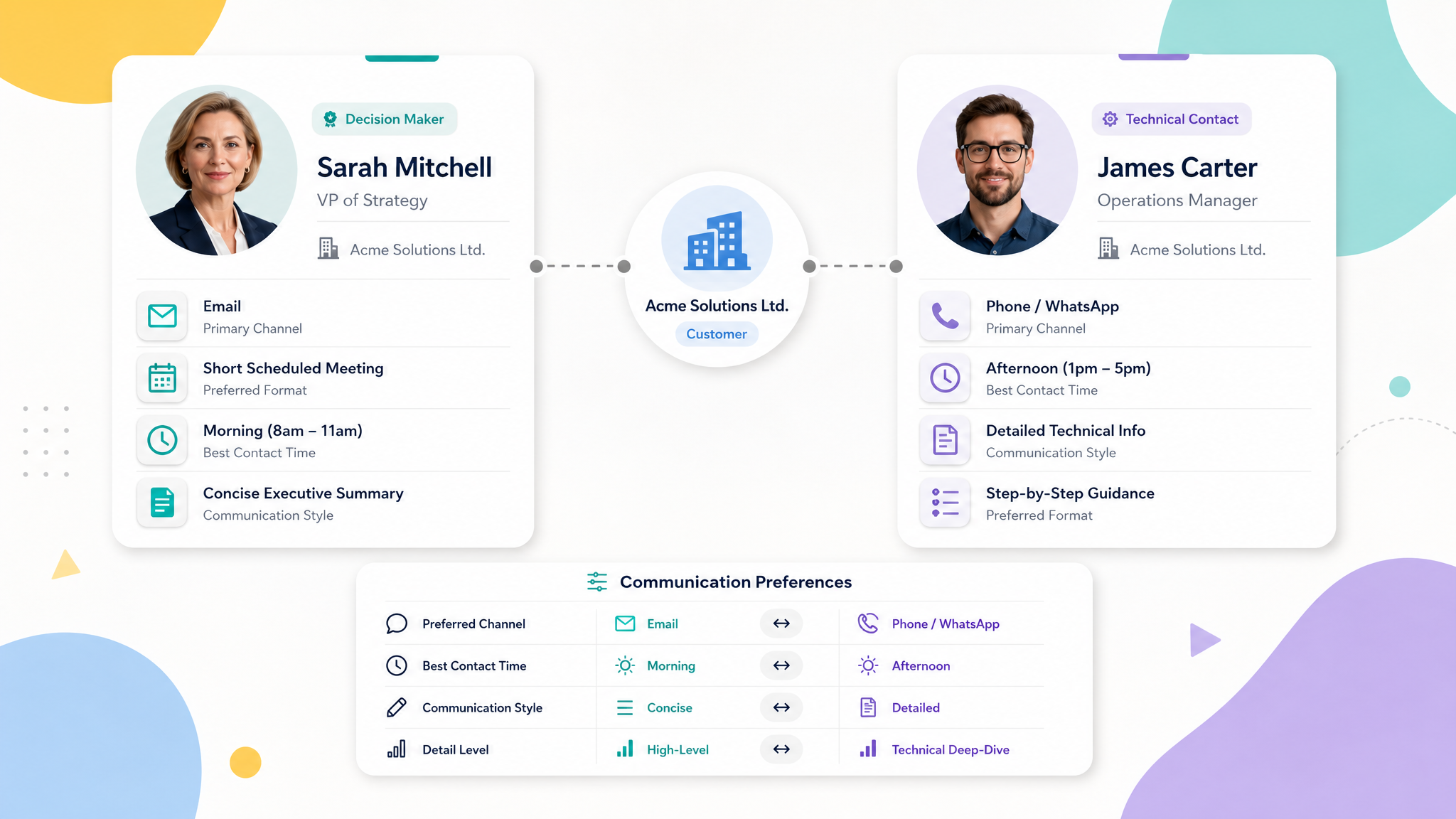
Customer communication preferences in CRM make information such as channel, contact frequency, suitable time, and relationship tone visible, enabling more appropriate customer communication.
Why is a customer communication preference more than a choice between telephone and email?
Customer communication preference is often reduced to the question “telephone or email?” In B2B relationships, however, preference has a broader context. Some customers want to receive detailed technical information by email, while others prefer to discuss critical matters in a short meeting. Some decision-makers expect a summary, whereas some users want a step-by-step explanation.
Managing communication preferences in CRM creates a more respectful and effective form of contact with the customer. Conversations become more productive when the sales representative knows not only the customer’s contact details, but also how the customer prefers to be approached.
Why do channel, timing, and tone matter in B2B relationships?
Communication with corporate customers involves many people. A procurement officer, technical team, manager, field user, or finance officer may have different expectations within the same process. Approaching all of them through the same channel, at the same level of detail, and in the same tone is often ineffective.
For example, the technical team may request detailed documentation while the manager expects a short decision summary. The procurement unit may focus on commercial terms, while the user team wants to understand ease of implementation. Recording these preferences in CRM enables the representative to prepare more deliberately before every interaction.
Preferred channel and suitable contact time
Some customers like to speak quickly by telephone, while others prefer email because of a busy schedule. Some contacts are easier to reach in the morning, while others accept meetings on particular days of the week. Although these details may seem small, they directly affect the quality of the relationship.
CRM can store information such as preferred channel, suitable contact time, hours when the customer does not want to be called, meeting preference, or a request for a written summary. The customer then does not have to explain the same communication habits to every new representative.
Different communication language for the decision-maker and the user
Not every contact is persuaded by the same language in B2B sales. Strategic benefit, investment rationale, and operational impact stand out for a manager, while everyday convenience, speed, and the support process are more important to a user. The technical team may want to see integration, infrastructure, data flow, or implementation details.
Keeping only a person’s title in CRM is therefore not enough. The subjects the contact considers important, the level of detail they prefer, and the concerns they have expressed in previous conversations are also valuable information. This context makes sales communication more personalized and professional.
Which fields can be used to track communication preferences in CRM?
Communication preferences can include preferred channel, suitable contact time, requested information format, role in the decision process, level of detail, sensitivity notes, and lessons from previous communication. These fields should not become unnecessary bureaucracy, however. A simple structure that the sales team will genuinely use is more efficient.
Some information can be kept in selection lists and some in short notes. What matters is linking it to the contact or company record and making it easy to see before a conversation. If the information exists in CRM but the representative cannot reach it at the moment of the meeting, it creates no operational value.
How do communication preferences improve sales quality?
Communicating through the customer’s preferred channel, at the preferred time, and at the right information level improves sales quality. The representative calls at the wrong time less often, sends fewer unnecessary details, and presents information in the format the customer expects. This increases the likelihood that the customer will respond.
Communication preferences also preserve relationship continuity when teams change. When a new representative takes over the customer, they see not only the contact details but also how the relationship should be managed. This allows the customer to feel the company’s organizational memory.
Manage customer communication with more context using Konguru CRM
Konguru CRM brings company, contact, visit, note, task, and offer information together in the customer context. When communication preferences are added to that context, the sales team can contact the customer not merely often, but in the right way.
In B2B sales, communication quality often affects the direction of an opportunity. Knowing which channel, time, level of detail, and tone a customer prefers provides the sales team with a more professional foundation for relationship management.
Request a Konguru CRM demo to manage customer communication preferences in CRM with more context and continuity.