

.svg)





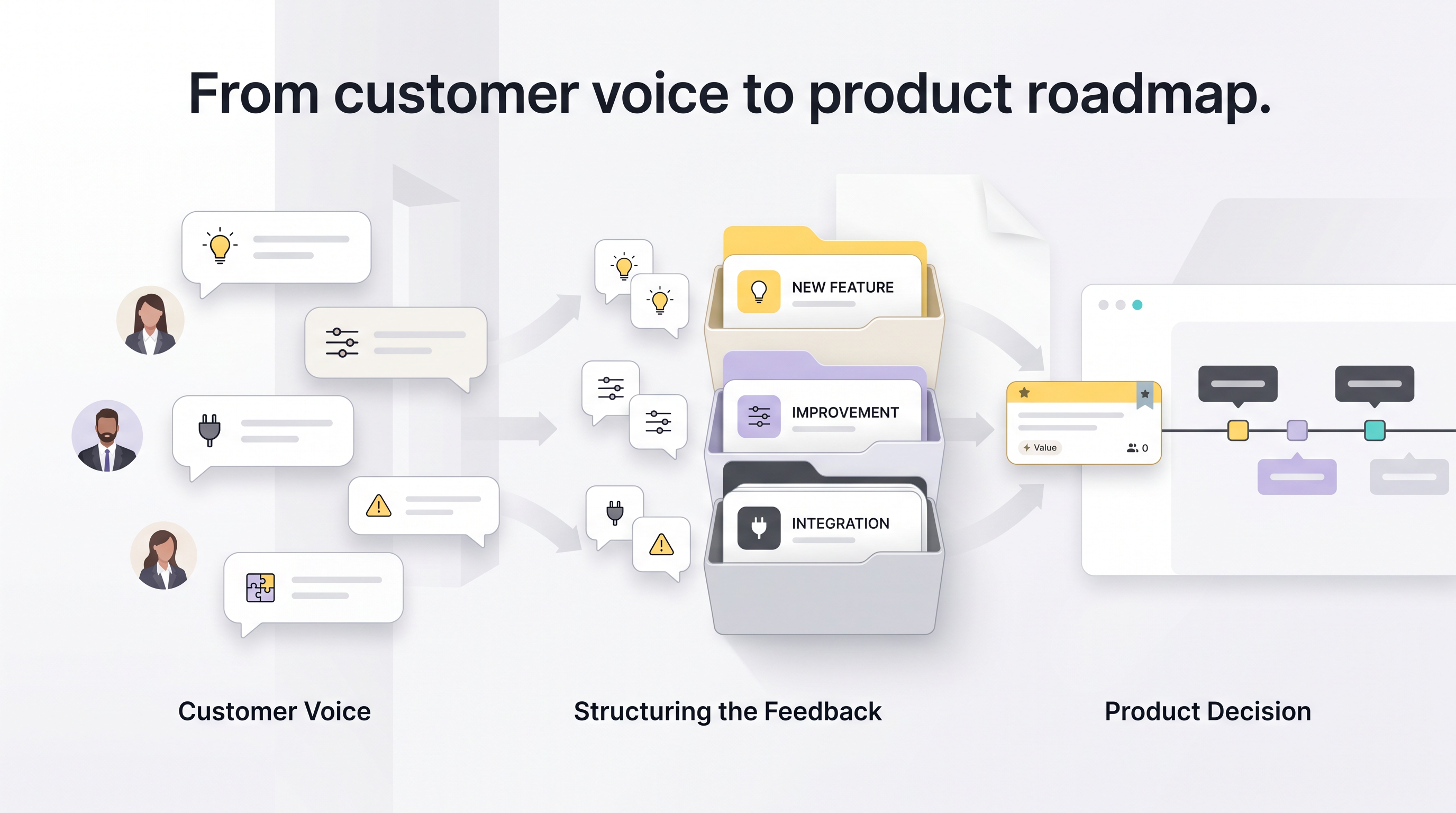
Product feedback and feature request management in CRM enables sales teams to relay customer needs from the field to product development teams in a more structured way.
Why do product requests from the field get lost?
In B2B software and SaaS companies, sales teams do more than create sales opportunities; they are also among the first teams to hear customers' product expectations. During demos, pre-proposal evaluations, live usage meetings, or visits to existing customers, new feature requests, improvement suggestions, and integration needs come to the fore.
If this information is not transferred into a structured system, it remains in personal notes, email threads, or people's memories of meetings. When a sales representative changes, the request may be forgotten, and even if multiple customers repeatedly mention the same feature, the product team may not see the scale of that repetition. Product feedback should therefore be handled in CRM together with its customer and opportunity context.
How can feature requests be distinguished from complaints?
The first distinction in product feedback management is to clarify the type of request. Not all customer feedback is a complaint. Some feedback points to an existing problem, while other feedback may concern a new use case, an additional reporting need, a different authorization expectation, or a new integration request.
When this distinction is not made correctly, the product team struggles to determine which request is a bug, which is an improvement, and which is new development. The sales team also cannot give the customer a clear response. For this reason, the request type, customer context, and commercial impact should be recorded together in CRM.
Distinguishing new needs, improvement suggestions, and integration requests
A new need is a capability the customer requests that is not currently available in the system. An improvement suggestion means making an existing feature easier, faster, or more comprehensive. An integration request is an expectation that CRM will exchange data with another system.
These three types of requests should not be evaluated in the same way. A new feature may enter the product roadmap, an improvement may enhance the user experience of an existing module, and an integration request may require a separate analysis based on technical scope and customer priority. Making this distinction in CRM allows requests to be classified more accurately.
Customer value and the commercial impact of the request
Not every feature request has the same priority. One request may be specific to a single customer, while another may create shared value for many customers. Some requests may accelerate closing a sale, some may increase adoption by an existing customer, and others may provide only a minor operational convenience.
Therefore, when a request record is created, information such as the size of the customer, opportunity value, recurrence of similar requests, strategic importance, and impact on usage should also be considered. This enables the product team to prioritize requests by business value rather than simply by the order in which they arrive.
How should the sales team record product feedback?
For the sales team, recording feedback should be practical. If requests are collected through overly complex forms, representatives may postpone entering the information into the system. However, if the record is left too unstructured, it will not produce meaningful data for the product team. A balanced structure is required.
Fields such as a brief description of the request, request type, related customer, meeting date, affected module, the customer's use case, commercial impact, and expected timing provide a sufficient starting point. Where possible, the record should be linked to the customer meeting note or related opportunity. This allows the product team to see the request not as an abstract wish, but together with its real customer context.
How can the product team use this data?
For the product team, feedback coming from CRM is a valuable source for understanding the market's real needs. If requests frequently concern a particular module, its user experience can be reassessed. If similar customer groups ask for the same feature, a new theme may emerge on the product roadmap.
It also becomes easier for the sales team to respond to the customer when the product team provides status information on requests. Is the request under review, has it been added to the roadmap, is it out of scope, or is there an alternative solution? This visibility helps the sales team communicate with customers more reliably.
Connecting field intelligence to product decisions with Konguru CRM
Konguru CRM helps manage company, contact, opportunity, visit, and note information in the customer context. When product feedback and feature requests are linked to this context, information coming from the field becomes more institutionalized.
For SaaS and B2B software companies, the voice of the customer heard by the sales team is an important competitive advantage. Collecting and classifying that voice systematically and carrying it into product decisions both strengthens customer relationships and contributes to setting product development priorities more effectively.
Request a Konguru CRM demo to manage product feedback from the field together with its customer and opportunity context.